
How to Prove a Song Is Yours in 2026: Criteria, Evidence, and Real Legal Risks
Understand which types of evidence carry legal weight in today's Brazil, accepted forms of proof, and the obstacles faced by composers
Redação Música 360º
Redação Música 360º
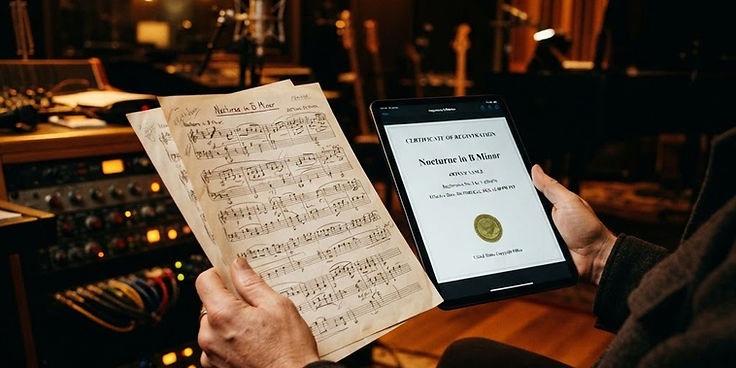
The assertion of song authorship has gained new layers of complexity in the Brazilian music scene of 2026. The increase in copyright disputes, driven by both the growth of the independent market and the multitude of distribution platforms, brings a central challenge: after all, how do you prove a song is yours when faced with real legal questioning? Understanding the criteria and practices accepted as proof is essential for anyone wishing to safeguard their compositions.
Authorship Evidence in 2026: Evolution of the Concept and Legal Boundaries
Brazilian copyright law continues to grant the author the exclusive right to register, exploit, and claim their work. However, proving authorship has never depended solely on a registration: it is essential to gather documents and evidence that can be presented in case of a challenge. The major change in 2026 is the increased demand for the quality of such evidence, in response to the volume of disputes and new forms of collaborative creation, remixing, and generative AI.
For a long time, presenting a registration at the National Library or the digital system of the UFRJ School of Music was sufficient as the main evidence. Today, the evidentiary base is broader, requiring traceable elements predating publication—such as original file dates, work-in-progress versions, email histories, contracts, and increasingly, digital evidence with certified timestamps.
Practical Criteria: What Is Legally Accepted as Evidence
By 2026, Brazilian courts and music sector arbitration bodies value evidence that attests to authorship, date, and the creative process of the work. Among the main accepted elements are:
- Formal registration (with official bodies or recognized entities)
- Invoices or contracts documenting rights transfers, co-authorships, and negotiations
- Digital files with preserved metadata and timestamp
- Electronic messages (emails, creative exchange platforms) that attest to the development of the song
- Reliable testimonies, especially from those involved in the creative process
Shallow documents or those of dubious authenticity carry little weight in current judgments. Practices such as posting the song on social media or mailing it to yourself remain legally weak, as they do not ensure unequivocal authorship or dating.
Recurring Challenges Faced by Composers
Currently, it is common for artists to only worry about authorship evidence when already facing a dispute or attempted misappropriation. The problem is that the absence of solid documentation can make it impossible to recognize authorship even for well-known creators. Risks are heightened in the digital environment, where snippets of songs, samples, and versions are being used in AI products without any public control.
Another significant challenge is the growing volume of collaborations. As songs are composed remotely, exchanged via cloud platforms or apps with little history, the risk of erasing the origin increases. Brazilian composers reported, in 2026 alone, dozens of cases where authorship evidence was discredited due to inconsistent dates or lack of proof of the creative process.
From Judicial Disputes to Revenue Blocks: Why Evidence Is Decisive
The absence of robust evidence is what most often leads authors to lose revenue or see their works vanish from platforms. In cases of dispute, recent court decisions have blocked earnings or ordered the removal of tracks until authorship is clarified. Streaming companies continue to be instructed to comply with court orders immediately, weakening the position of those unable to prove their authorship.
It is worth remembering that, even when authorship is recognized, the absence of evidence regarding assignments, partnerships, or splits can freeze receivables at ECAD and publishers, severely harming the composer's income. It is not enough to claim the song is yours: producing evidence must be a constant and strategic practice.
The Practical Scenario for Those Seeking Protection
Given this scenario, the market recommendation is to act before any conflict arises. Each new composition should be documented, with files saved on trusted platforms, secure sharing with co-authors, and, above all, formalization of authorship registration. In Brazil in 2026, digital registrations with certified timestamps have come to be accepted in court, providing robust security. Documents demonstrating the creative process, from preliminary notes to final versions, are also recommended.
The risk of litigation has increased proportionally to the ease of releasing and sharing content. It is no longer uncommon to see songs registered almost simultaneously by different people, in different regions and on different platforms, which reinforces the need for registrations accompanied by multifaceted evidence—including, whenever possible, testimonies, digital histories, and contracts.
The Role of Grupo Música 360º in Registering and Shielding Works
Professional operation of music registrations is essential in 2026: not only to guarantee authorship but also to safeguard financial and reputational results. Grupo Música 360º handles the entire Music Registration service, coordinating everything from document preparation, formalization with recognized entities, to organizing digital and historical evidence associated with the creation of the work. Each project receives individualized treatment, considering the shielding needs in light of current legal risks.
Grupo Música 360º's work includes strategic legal guidance on the most suitable types of evidence for each case, registrations with timestamps, split documents, and contracts between co-authors. The entire organization of the evidentiary collection is designed to withstand challenges in court, protecting not only authorship but also the rights derived from that authorship. If you need to ensure the song is truly yours, contact the Grupo Música 360º team via WhatsApp to start your process with complete security and support.
Transformation of Authorship Culture and Future Trends
The contemporary dynamic values more than just the release or popularity of a work: the new currency is the ability to prove its origin. Public recognition of the author remains crucial, but those who do not invest in structured evidence risk their own artistic trajectory. With technological advances and the growth of disputes involving AI, documentation and registration requirements are only expected to increase.
At the center of this movement, planning registration and copyright protection with strategic vision is a basic requirement for anyone serious about their music career. Building evidence, organizing the collection, and updating documentation practices turn music into shielded assets, capable of withstanding trends and resisting increasingly sophisticated litigation in the 2026 market.
Grupo Música 360º
Sua música também pode chegar mais longe.
O Grupo Música 360º trabalha com divulgação musical e produção de conteúdo para artistas, bandas, produtores e gravadoras. Fale com a nossa equipe pelo WhatsApp e apresente o seu projeto.