
How to Prove Authorship of a Composition in 2026: Legal Criteria and Truly Accepted Evidence
Understand the mechanisms used in Brazil for authorial proof, the weight of each type of evidence, and the pitfalls still present in the legal recognition of musical authorship.
Redação Música 360º
Redação Música 360º
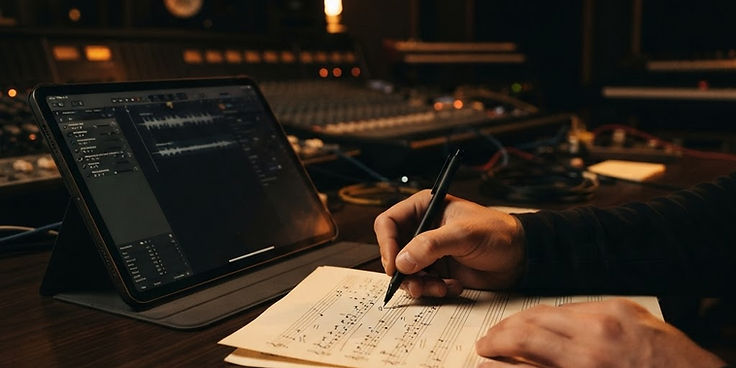
In Brazil in 2026, the discussion about musical authorship has never been more relevant. The advancement of digital technologies, combined with the ease of file circulation, has opened new frontiers of exposure for artists but has also heightened the risks of disputes and plagiarism. Many composers face a practical challenge: which paths, in fact, count as legitimate proof in the legal recognition of a composition's authorship?
What Counts as Proof of Authorship in 2026
In court disputes, the criterion of documentary precedence prevails. More than just creating, it is necessary to demonstrate, with reliable and dated documentation, that the work has belonged to the author since a certain moment. Home recordings, digital files, dated emails, assignment or co-authorship contracts, and even social media posts can make up a set of evidence—but none of them, in isolation, guarantees legal supremacy in the face of more complex challenges.
Recognition of authorship does not replace the need for registration, but the process of proving authorship often arises even before the composer decides to formalize their work. In 2026, there is still a difference between automatic protection (guaranteed by copyright at the moment of creation) and the objective evidentiary value of the proofs presented in case of dispute.
Digitization, Metadata, and the Limits of Traceability
The growth of digital tools for production and storage has brought new dynamics to the proof of authorship. Digital files incorporate metadata that record creation dates, modifications, and, in some cases, even geolocation. However, this information has relative value: it can be easily manipulated and therefore requires a chain of custody to attest to its integrity—something not always trivial without technical or expert support.
The use of digital distribution platforms helps with traceability but should not be confused with legal recognition. Releasing a track on major streaming services in 2026 does not imply unequivocal authorial recognition. The music can be published by third parties, and the certificate issued by platforms generally does not equate to documentary registration before the law.
Legal Procedures and the Weight of Documentation
In lawsuits over authorship, official documents prevail, such as registrations with competent bodies, signed contracts, proof of file deposit (at a notary office or platforms recognized for their institutional reliability), as well as technical expert reports. Testimonies may be considered, but their weight is secondary compared to concrete evidence.
Demands involving co-authorship and partnerships continue to be a frequent source of litigation in the Brazilian music scene. The prior formalization of authorship and rights division agreements, through signed contracts, drastically reduces the risk of unproductive disputes. Communication failures, lack of physical records, and even unauthorized changes in the creative process are among the main points of contention in 2026.
The New Scenario of Digital Evidence: Opportunities and Weaknesses
Decentralized tools, such as blockchain, are already used to create immutable records of authorship. However, the application of these methods still does not replace the need, before the Brazilian courts, to prove authorship through official documents. Digital protocols bring agility and help compose the ownership history, but they remain subject to judicial acceptance if the production chain of the records is not well documented.
Another practice that has become popular in recent years is sending compositions to oneself by email or registered mail. In 2026, case law has already relativized the validity of these strategies: they are accepted in conjunction with other elements, never as absolute proof. The risk of manipulation and the ease of tampering with digital dates have already been recognized in courts, reinforcing the requirement for multiple consistent indications.
Analysis: What Has Changed and What Has Not
The multiplicity of digital evidence has increased the value of organized documentation of creative processes. In 2026, it is not enough to create: it is necessary to record the behind-the-scenes of the process. Messaging groups, collaborative software, and digital drafts have ceased to be mere accessories and have become an essential part of the composer's dossier.
Despite advances, old practices such as keeping handwritten notebooks and original recordings remain valuable instruments in case of disputes. The combination of these strategies—digital and physical—is still the most robust path to navigate authorship disputes.
Market Practice: Most Common Mistakes and Vulnerabilities
Artists continue to underestimate the need for formal documentation, imagining that the public release of the music itself is enough to guarantee rights. Another recurring mistake is relying exclusively on platforms or social networks to prove originality. In lawsuits and negotiation processes, the lack of clear contracts regarding co-authorship, deadlines, and division percentages still fuels lengthy and financially burdensome disputes.
In 2026, the Brazilian scenario remains vulnerable for composers who ignore expert recommendations on document organization. Digital self-confidence, typical of rapid releases, can turn into a weakness if real disputes arise.
How Grupo Música 360º Executes the Music Registration Service
Given this scenario, the Registrar Musica service from Grupo Música 360º proves decisive for composers who wish to navigate the 2026 market without exposing their work to unnecessary risks. From the complete survey of creation materials to formalization in official records, the team guides, documents, and prepares the entire evidentiary dossier, ensuring the integrity and legal validity of authorship. Grupo Música 360º also works on drafting and reviewing co-authorship contracts, organizing digital production processes, and guiding best practices so that the composer has, in fact, efficient authorial protection in the face of market challenges and possible disputes.
For musicians and professionals who want security not only in creation but also in the practical stage of proving authorship, the way is to speak directly with the Grupo Música 360º team on WhatsApp and present their project. Each stage of the service is designed to offer concrete protection, aligned with the legal and technological context of the current Brazilian scenario.
Proving the authorship of a composition in 2026 no longer depends only on talent or inspiration. It requires documentary discipline, mastery of legal tools, and constant attention to market dynamics. Authorial recognition, with its artistic and financial value, is only sustained in practice when professional support accompanies the artist from start to finish.
Grupo Música 360º
Sua música também pode chegar mais longe.
O Grupo Música 360º trabalha com divulgação musical e produção de conteúdo para artistas, bandas, produtores e gravadoras. Fale com a nossa equipe pelo WhatsApp e apresente o seu projeto.