
How to Register Your Own Composition in 2026: Steps, Criteria, and Everyday Dilemmas of the Composer
Understand what truly matters when registering original compositions in Brazil, beyond traditional procedures and the most common legal questions.
Redação Música 360º
Redação Música 360º
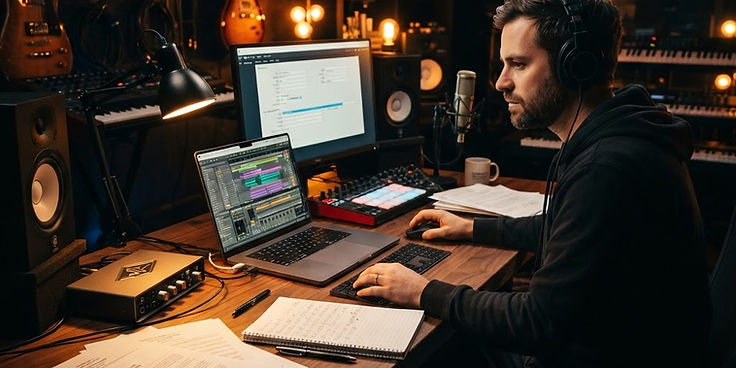
The reality of Brazilian music composers in 2026 is marked by a large volume of original works circulating among digital creations, online collaborations, and fast-paced publishing flows. In this scenario, the decision to register your own composition is no longer a mere formality but has become an essential layer of security, credibility, and autonomy over the work.
Music registration in 2026: more than a bureaucratic step
In the hyperconnected world of original productions, registration is not just a protocol to guarantee rights with official bodies or collection societies. It has become a strategic step that separates raw creation from the legitimate recognition of authorship in the digital environment and the traditional market. The absence of registration can open gaps for both legal controversies and devaluation of the work in the release and negotiation circuit.
In 2026, with the sophistication of authorship tracking mechanisms and the integration of blockchains into official registries, practical questions persist: what to register, when to formalize authorship, what evidence is accepted in case of litigation, and how to avoid overlaps in collaborations. Such issues directly affect the careers of those who compose, produce, or invest in original music.
Essential steps to register your own composition
Registering a composition is still, above all, a move to protect and value your creative identity. The process, in 2026, includes preparing the files, defining the holders and partners in the work, meeting legal requirements (such as clear identification of the parties, attachment of the original content, and approval of declarations), as well as filing in a secure environment that validates the existence and integrity of the material.
Documentation of lyrics, scores, arrangements, or audio must be precise—a common mistake is submitting unfinished versions or files without proper dating. The inclusion of co-authors and proof of participation, especially in collaborations via digital platforms, requires formalized consent, avoiding later disputes over authorship recognition.
The proof stage occurs both by submitting the material to recognized protocols and by obtaining digital certificates and a legal log of the registration. In critical situations, such as suspected plagiarism or misappropriation, these documents are what provide the artist with support before the Judiciary or mediation bodies.
What changed in 2026 in the daily routine of copyright registration
The advancement of automatic work identification technologies has expanded the role of registration as a criterion for record contracts and licensing for soundtracks, jingles, or audiovisual synchronizations. Traceability has become an entry criterion for incentive notices and public cultural policies aimed at new media.
Recent legislative adaptations have reinforced transparency obligations in identifying the holders of the work, encouraging the formalization of registrations before public release—especially in repertoires with multiple authors, where clarity about participation is crucial for performance and streaming revenues.
Practical developments and recurring mistakes
The ideal flow starts with a detailed survey of everything to be submitted: lyrics, melody, arrangement, and possible edits. A recurring mistake is waiting to register only after release, a time when risks of leaks or plagiarism already exist—it is recommended to protect beforehand, even for works that will go through later versions.
Another pitfall is the lack of documentary clarity among creative partners. The absence of contracts or agreements defining co-authorship strengthens litigation and makes it harder to defend authorship in legal disputes. Registering your own composition is, above all, about safeguarding creative relationships and securely inserting the work into the music economy cycle, for both authorial and commercial purposes.
Grupo Música 360º: music registration with security, guidance, and traceability
In the dynamic music environment of 2026, Grupo Música 360º offers end-to-end Music Registration services, handling everything from document analysis to formalization with official bodies. Support includes direct guidance at each step, risk identification, protection against legal gaps, and validation of digital evidence with recognized legal force. Projects received by Grupo Música 360º benefit from detailed consultancy in organizing authorial participation, drafting assignment or co-authorship instruments, and filing compositions in auditable systems, which facilitate the defense of rights in any scenario.
Artists, producers, and composers thus gain specialized technical support and assurance that every detail is suitable for future contracts, licensing, or international circulation. The service is structured to meet urgent demands and original works from different genres, always focusing on autonomy, agility, and total legal security. Contact the Grupo Música 360º team via WhatsApp and present your project to find the safest path for your composition.
Submitting the registration of your own composition with care, documentary precision, and specialized follow-up not only prevents vulnerabilities in the copyright circuit but also concretely adds value to the work. In 2026, this care is a strategic differentiator—a true investment so that each creation gains the space, recognition, and protection it deserves in the face of contemporary market challenges.
Grupo Música 360º
Sua música também pode chegar mais longe.
O Grupo Música 360º trabalha com divulgação musical e produção de conteúdo para artistas, bandas, produtores e gravadoras. Fale com a nossa equipe pelo WhatsApp e apresente o seu projeto.