
Melody copyright in 2026: paths to register, protect, and add value to musical creations
Understand what guarantees the authorship of a melody, the nuances of registration, and the challenges of shielding in the digital landscape.
Redação Música 360º
Redação Música 360º
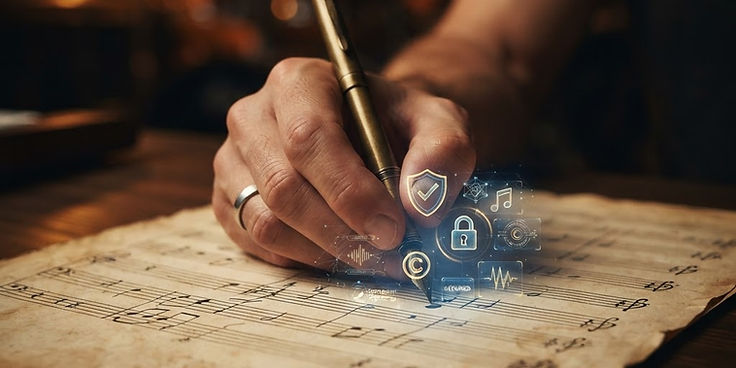
Few areas of music challenge the notion of authorship as much as the creation of melodies. In 2026, the debate over melody copyright is expanding due to new automated music generation technologies, global content flows, and the ease of access to already published works. Registering the melody — not just the lyrics or the harmony — has become a central concern for composers, publishers, and performers who seek to add value to their work and avoid litigation.
What are melody copyrights and why do they matter
The melody makes up the basic identity of a song and, legally, can be protected as a unique intellectual work, provided it possesses originality and does not constitute a mere common sequence or public domain work. Brazilian legislation treats the registration of a melody with rigor: it requires clear proof of authorship, delimitation of the melodic sequence, and precise identification of the creator. In a scenario with musical AI assistants, the risk of melody overlapping has never been more relevant.
Unlike lyrics, the melody is often the target of fierce disputes, as the recognition of similarities can be subjective — and legal backing will require technical criteria, expert reports, and comparative analyses. The role of prior registration, in turn, is decisive: it protects the creator from the risk of misappropriation and serves as a foundation for future claims.
The Brazilian specificity in melody registration
In Brazil, melody registration occurs primarily at the National Library (Biblioteca Nacional), although this is not mandatory to guarantee the right — what counts is the proof of authorship. Even so, the registered document is the evidence with the highest legal value in disputes, especially in the absence of prior contracts or agreements. In 2026, the digital universe brought innovations: supplementary evidence based on blockchain, reliable timestamping, and encrypted digital files are now accepted.
Another national nuance: while lyrics are quickly identifiable, the melody depends on a transcribed score or audio signature, requiring extra care in preparing the material and attention to technical details. Minor notation errors or lack of detail can undermine an entire authorship claim process.
How melodic copyright protection works beyond lyrics
Protecting only the lyrics does not shield the whole: melodies can be plagiarized in arrangements, jingles, soundtracks, or instrumentals in a subtle and often hard-to-track manner. Complete registration of the melodic work — especially in instrumental compositions or songs with a strong melodic identity — becomes a competitive differentiator and a market value asset.
That is why more and more artists and publishers are investing in rigorous documentation routines. This includes storing intermediate versions, registering detailed scores, and compiling evidence of the creative process. This culture of documentation reduces risks and strengthens bargaining power, including in editorial negotiations and public tenders, where melodic ownership affects international contracts and the collection of related rights.
Recent challenges: AI, sampling, and the border between inspiration and plagiarism
In 2026, musical artificial intelligence tools can create melodies based on large repositories of works, blurring the line between homage, inspiration, and, in extreme cases, plagiarism. The challenge has become unprecedented: even authentic creations can, by chance, coincide with existing sequences. Brazilian and international courts have given weight to the context, the demonstrated creative process, and the existence (or absence) of intent.
Based on this scenario, it is urgent that authors maintain not only the final registration but also evidence of the development of the melody — from initial sketches to alternative versions stored on reliable platforms.
Another trending element: the issue of sampling and melodic citations in remixes. Often, small melodic cells are reused, especially in pop, electronic music, and hip hop, creating discussions about the threshold of copyright and creative freedom.
Practical implications for composers and publishers
Registering the melody is an urgent step for any professional who wants to ensure shielding, value, and recognition for their work. The process must be rigorous: it requires faithful transcription in a score — even for those not fluent in musical writing —, a reference recording, clear identification of the authors, and precise dating.
Negligence in this path can be costly: in litigation over usage rights, the absence of a well-crafted registration makes judicial recognition of authorship unfeasible. Furthermore, paying attention to international legislation is essential, as disputes over works performed outside Brazil require documentation compatible with local regulations and multilateral agreements.
How Grupo Música 360º executes end-to-end melody registration
In the current scenario, protecting melody copyrights requires technical knowledge, precise interpretation of regulations, and mastery of digital authentication tools. Grupo Música 360º structures the "Registrar Musica" service to ensure maximum security: from the technical analysis of the melody, through writing and reviewing the score, to access to advanced digital registration solutions with recognized legal validity.
For artists, production companies, and publishers seeking full protection, Grupo Música 360º conducts all stages — document collection, preparation of necessary files, interface with registration bodies, and post-registration follow-up. It also provides guidance on the technical criteria that will actually be accepted in cases of dispute: details that make the difference between having your work protected or leaving it vulnerable to the risks of the current market.
If you are developing compositions and need to ensure authorship security (in Brazil or abroad), contact the Grupo Música 360º team via WhatsApp and present your project for personalized service.
Melodic shielding goes beyond the basics: why it matters in 2026
It is not just about filling out a form or having a score archived. In the competitive and dynamic environment of 2026, with the accelerated circulation of music and the action of generative algorithms, any oversight can compromise years of creative work. The registration of the melody, done carefully, is what separates the author from the amateur, and defines the space for recognition, fair remuneration, and legal defense.
The valuation of melodic authorship — especially in times of disruptive technologies — is what sustains the diversity, originality, and vitality of the Brazilian and global music market.
Grupo Música 360º
Sua música também pode chegar mais longe.
O Grupo Música 360º trabalha com divulgação musical e produção de conteúdo para artistas, bandas, produtores e gravadoras. Fale com a nossa equipe pelo WhatsApp e apresente o seu projeto.