
Music Protection in 2026: From Blockchain to New Legal Frontiers
How new technologies and legal adjustments are redefining the landscape of music protection in Brazil and worldwide
Redação Música 360º
Redação Música 360º
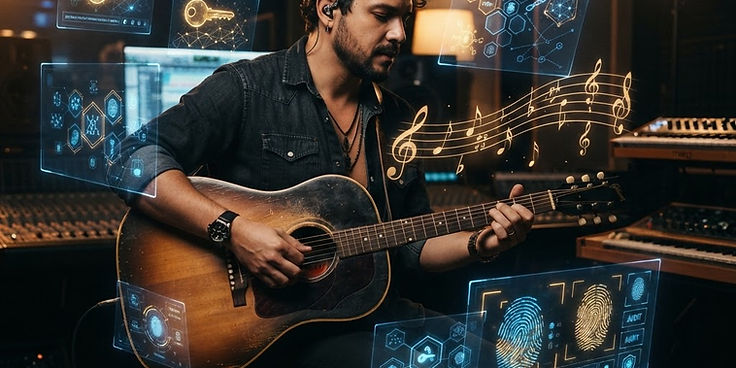
The technological consolidation in the digital environment and the advancement of legal debates have brought unprecedented urgency to the discussion about music protection in 2026. At a time when creating, distributing, and monetizing songs has never been so accessible, protecting works against misuse has become a concrete concern for composers, performers, publishers, and record labels alike.
New Protection Dynamics: From Physical to Digital
The traditional model of music protection—centered on formal registration with bodies such as the Biblioteca Nacional and the actions of ECAD—remains relevant but is losing prominence in the face of fragmentation and the speed of innovation. In 2026, smart contracts based on blockchain are beginning to offer alternatives for registration, tracking performances, and distributing royalties with a level of transparency previously unattainable by conventional systems.
On the international scene, major publishers and distributors have started adopting hybrid solutions, combining storage on public and private blockchains with databases protected by local legislation. In Brazil, small record labels and independent musicians have migrated part of their catalogs to platforms that promise instant traceability of musical works usage.
Blockchain: Potential and Practical Challenges
The hype around blockchain for music protection has lasted for years, but in 2026 the promise is taking on more tangible contours. The immutable registration of information about authorship, dates, and changes allows any user to prove the existence of a song, which weakens legal disputes over plagiarism or unauthorized use.
However, regulatory hurdles persist: blockchain registrations still do not fully replace legal recognition in Brazilian courts, and interoperability with international systems is partial. For the artist, this means that relying solely on blockchain solutions, without institutional backing, still carries risks—especially in markets where piracy and illicit use remain acute challenges.
Artificial Intelligence and New Risks
Composers and producers are already facing another disruptive phenomenon: the proliferation of works created by artificial intelligence. Tools capable of generating original melodies and lyrics or imitating established styles expand the repertoire but complicate the notion of authorship and protection.
There are notorious cases, documented by specialized portals such as Music Business Worldwide, of AI-created songs being contested for alleged style infringement or use of protected excerpts—which pressures collective management societies and regulatory bodies to rewrite part of the legal framework for music protection in the digital age.
The Role of Major Players and Recent Movements
Spotify, Apple Music, and other streaming giants have been investing in proprietary monitoring protocols, using artificial intelligence to detect unauthorized use in music uploads. At the same time, artist movements gathered in international associations are seeking to influence the regulatory agenda in major markets, aiming to ensure clear channels for claims and fair remuneration.
In Brazil, organizations such as the União Brasileira de Compositores (UBC) promoted debates in 2026 on updating the Copyright Law, discussing topics such as the protection of samples, remixes, and works created by AI, always from the perspective of creator security.
Reaction of the Independent Scene and Practical Challenges
The independent scene, which represents a significant share of new productions in the country, has found in online collaboration and technology more agile means to protect their music. Among the emerging solutions are decentralized platforms for registering works and digital fingerprint tools capable of tracking every performance on the internet.
Even so, many musicians report difficulties in proving authorship in international contexts, where the hegemony of traditional registrations still prevails, and there are vulnerabilities in online enforcement. Therefore, for the independent artist, the scenario requires a combined strategy: formal registration, adoption of technological solutions, and constant monitoring of their works in the digital environment.
The Reader and New Routes for Music Protection
Those who compose, produce, or manage repertoires need, more than ever, to understand the ecosystem: traditional registration has not been replaced, but expanded by digital tools that, when well used, offer real advantages in proving authorship and distributing revenues. Success in music protection in 2026 lies in combining tradition and innovation. The attentive creator should stay up to date, consult reliable sources, and weigh protection strategies on a case-by-case basis.
As artists, publishers, and new tech players reorganize, Grupo Música 360º continues to closely monitor these movements. The team investigates trends, experiments with tools, tests the security of new solutions, and produces comprehensive guides on every development in the music market.
Musicians, producers, and entrepreneurs seeking not only to protect but also to enhance their works can count on the editorial experience and exclusive channels of Grupo Música 360º: whether to launch a single, give visibility to an album with a special feature, or schedule exclusive interviews, we offer a professional approach and connection with an engaged audience in the 2026 music universe. To present your project, ask questions about music protection, or learn about promotional opportunities, just contact our team via WhatsApp.
The transformation of music protection methods does not mean insecurity—it is a symptom of a dynamic market, attentive to the creator's legitimacy and the ethical circulation of works. Those who follow this movement, invest in information, and update their strategy are one step ahead in building a solid and sustainable career in today's music scene.
Grupo Música 360º
Sua música também pode chegar mais longe.
O Grupo Música 360º trabalha com divulgação musical e produção de conteúdo para artistas, bandas, produtores e gravadoras. Fale com a nossa equipe pelo WhatsApp e apresente o seu projeto.