
Music Registration with Certificate in 2026: What It Is, Who It’s For, and Its Legal Weight
The music registration certificate takes center stage in 2026 by meeting demands for robust proof of authorship, market value, and security in disputes.
Redação Música 360º
Redação Música 360º
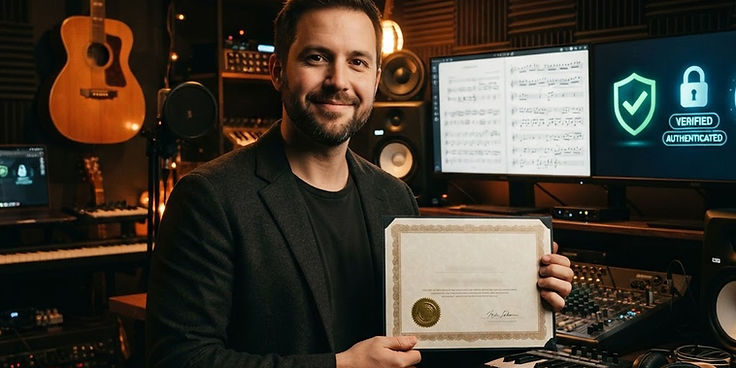
Amid the increasingly dynamic digital environment of the 2026 music market, music registration with a certificate has become a key element for composers, producers, and publishers seeking to protect works in a robust and legally recognized manner. The registration certificate, in addition to formalizing authorship, serves as an essential document in negotiations, licensing, and legal disputes, adding value and seriousness to the registered work.
Certificate: From Legal Support to Market Reputation
Obtaining a music registration certificate goes beyond mere formality. In recent interviews within the music sector, executives confirm that presenting this document is often required when signing contracts for synchronization, public calls, or negotiations between publishers and artists. More than that: in legal demands, the certificate represents robust and immediately recognized documentary evidence, facilitating the handling and decision-making in cases involving authorship disputes, property rights, or plagiarism cases.
Since 2023, with the popularization of digital registrations, the certificate has been made available in electronic format, with authenticity seals that guarantee its validity before official bodies and the market itself. In the 2026 context, this standard has not only remained but has become more sophisticated: the document carries creation metadata, dates, and authors, integrating with blockchain systems and international databases. This makes the traceability and integrity of the information present in the certificate even more relevant for all parties involved in the music chain.
Who Needs It and What Are the Requirements in 2026?
Independent artists, rising bands, publishers, and even multinationals have turned their attention to music registration with a certificate in light of the increase in copyright infringement lawsuits and the rise in amounts paid for the use of music in advertising and digital platforms. Recent lawsuits—widely reported—have shown that the absence of a certificate can delay payments, block bookings at international festivals, and even make strategic partnerships unfeasible.
For 2026, the requirements remain clear: for the registration to be completed with a valid certificate, the creator must provide complete authorship data, clear identification of lyrics and melody (when applicable), as well as identification documents. In cases of co-authorship, all parties involved must formally authorize the procedure, which may cause delays—but also strengthens the legitimacy of the result. Negligence in this submission results in denials, incomplete certificates, and even risks of future litigation.
The Weight of the Certificate in Disputes and the Artist’s Daily Life
Having a registration certificate not only provides protection against plagiarism but also speeds up monetization processes in collective management societies, increases chances in public calls and incentive law notices, and opens doors for international collaborations. In catalog sales, the certificate has become a mandatory criterion in legal analysis offices.
Moreover, the document plays a central role in the distribution of revenues by digital platforms: in 2026, more and more composers and producers are turning to the certificate to avoid having funds withheld due to suspected authorship conflicts on platforms. Robust documentary evidence speeds up revenue releases and reduces losses.
From Technology to Practical Impact: Why Register with a Certificate?
Technological evolution has brought agility but also increased competition and risks: generative AI, deepfakes, and digital clones have created unprecedented challenges for authorial authenticity. In this scenario, the certificate, backed by official bodies and international standards, preserves originality and adds value to the work. The Brazilian market—and increasingly the international one—is already guided by the principle that those who present the registration certificate start from a privileged position, both legally and commercially.
However, the procedure requires technical knowledge, attention to detail, and follow-up from start to finish. Common mistakes such as poor work description, incorrect file attachment, or omission of co-authors have serious impacts. For this reason, the demand for specialists in music registration with certification grew in 2026—a trend that only reinforces the centrality of the document in music business.
Music Registration with Certificate Is an Essential Service in the Authorship Chain
At Grupo Música 360º, the Music Registration with Certificate service offers comprehensive support: from verifying authorship and technical requirements to formalizing the application, including guidance on metadata and preparation of documents in accordance with nationally and internationally accepted standards. The service includes clarifying doubts about ownership and co-authorship, assistance in correctly describing the work, and secure file submission, minimizing the risk of future challenges.
In 2026, Grupo Música 360º acts as a bridge between the creative universe and the technical protection required by the music industry, with internal workflows that allow not only registration with official bodies but also the management and updating of documents in assignment, negotiation, and rights transfer processes. The composer, producer, or publisher seeking predictability, support, and safe circulation of music finds a comprehensive solution at Grupo Música 360º. From the first analysis to the delivery of the certificate, the team follows each step as an essential part of the musical routine.
Those who wish to register their music with a certificate, ensure legal protection, and enable business can speak directly with the specialists at Grupo Música 360º via WhatsApp and detail their project to receive personalized service.
The expectation is that, in the coming years, the music registration certificate will become a protocol requirement—not only in public calls and agencies but throughout the business network, digital distribution, and festivals. Anticipating this new level of legal security is not just caution: it is a strategy to sustain a career, increase the value of the work, and avoid lengthy obstacles in future contracts.
The movement of 2026 makes it clear: in the world of creation, few documents are as decisive for the artist’s trajectory as the music registration certificate.
Grupo Música 360º
Sua música também pode chegar mais longe.
O Grupo Música 360º trabalha com divulgação musical e produção de conteúdo para artistas, bandas, produtores e gravadoras. Fale com a nossa equipe pelo WhatsApp e apresente o seu projeto.