
Music registration without leaving home in 2026: security, autonomy, and the composer's new daily routine
How professionals across all music segments have consolidated remote registration as a core practice and the impact of this advancement on the national scene
Redação Música 360º
Redação Música 360º
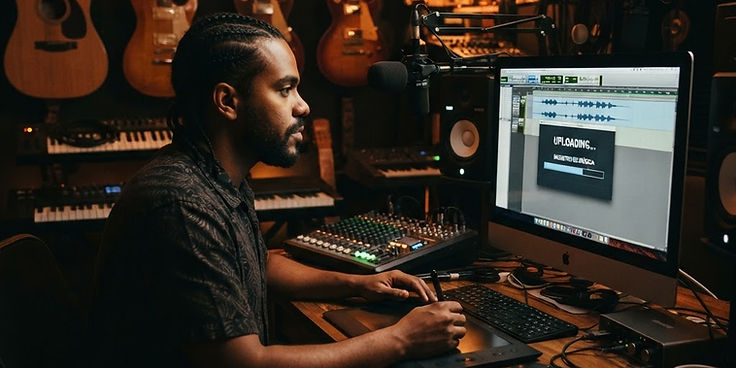
The year 2026 marks the definitive maturation of music registration without leaving home. In Brazil, the remote procedure has ceased to represent merely a pandemic-era emergency or a privilege restricted to large urban centers to become the standard path for copyright protection, impacting everyone from independent songwriters to established artists. The market's daily routine has reorganized around this convenience: from the living room to the studio, every creative cycle now incorporates digital registration as a fundamental stage of the workflow.
The consolidation of remote registration in musical daily life
Recent stories prove how remote registration has gained prominence: songwriters from the outskirts, home studio producers, and national record labels report that almost no project moves forward without obtaining a digital certificate of authorship. The growth of remote collaborations, the acclaim of tracks on digital platforms, and the rise of audiovisual synchronization have accelerated the adoption of this guarantee. The old fear of sending lyrics and melodies via email or storing home-recorded versions without authentication is a thing of the past.
Today, those who work professionally in music have not only learned to use authorized registration platforms but also to understand how the system works: technical requirements (such as digital signatures, accepted formats, clarity in author and co-author data), submission protocols, and secure archiving. Concern for the legal validity and historical traceability of music has become central to the dynamic digital market.
Practical benefits for creation and authorship management
The concrete impact of registering without leaving home goes beyond convenience: the ability to protect works immediately after they are created allows artists to release singles or collaborate remotely without the old risk of leaks or disputes. The security of registering everything from drafts to final versions brings confidence to partnerships, facilitates contract negotiations, and opens doors for audiovisual synchronization at the very embryonic stage of a project.
Another relevant point is democratization: musicians outside traditional circuits, far from notary offices or official bodies, now access the same level of protection, leveling the playing field. This scenario strengthens regional scenes, collectives, and new genres, expanding the plurality of the Brazilian musical catalog without demotivating bureaucracy.
Changes in creative dynamics and contracts
In 2026, the speed of registration allowed for unprecedented trajectories. Songwriters began to register compositions in real-time during virtual collaborative sessions, establishing precise authorship for each element. Hit-making hubs take advantage of the agile workflow to test arrangements and melodies without fear of undue exposure. Meanwhile, major publishers and producers are now requiring digital registration proofs before approving releases, music for soundtracks, or international licensing projects.
In contracts, the prior registration of the digitized work has become a standard clause, facilitating the inclusion of co-authorships, minimizing disputes, and providing greater predictability for future revenue from performance, streaming, or synchronization.
Criteria and risks in the digital process
Despite the advances, the digitization of registration demands attention to technical and legal details. Sending files in appropriate formats, clarity in author identification, verifying the integrity of digital documents, and safely storing original certificates remain prerequisites. Common errors such as missing attachments, incomplete or divergent information, and sending preliminary versions without consensus among those involved can still generate future questions about authorship.
From the point of view of Brazilian copyright law, only registration performed with recognized entities, with proper documentation, offers effective protection and probative force. Informal shortcuts or partial registrations – such as emails, unauthenticated audio, or social media posts – remain easily contestable. Thus, being guided by solid technical criteria avoids loss of rights and lengthy litigation.
How Grupo Música 360º executes music registration without leaving home
In the context of this new paradigm, Grupo Música 360º acts as a strategic partner for artists, songwriters, producers, and publishers who wish to register music without leaving home, with security and reliability. The service covers all stages of the process, from preparing files and providing document guidance to submission, monitoring, verification, and delivery of the final digital certificate.
Professionals at Grupo Música 360º analyze each case, verifying authorship, co-authorships, music formats, lyrics, and recordings, and execute the procedures with the authorized bodies. We monitor the protocol status, resolve pending issues, organize documentation, and provide secure storage of receipts for future legal demands or rights negotiations. With personalized service via WhatsApp, the artist can ask questions, present the project, and follow the progress of the registration in real-time, without travel and without the risk of missed deadlines or technical errors.
For musicians and producers seeking full legal security, the Registrar Musica service from Grupo Música 360º eliminates obstacles, reduces bureaucracy, and transforms remote registration into a fluid, reliable, and professional routine.
Reflections and perspectives for the Brazilian music market
The consolidation of remote registration in 2026 redefines not only the financial security of artists but also adds dynamism to the growth of independent music, encourages inter-regional collaborations, and strengthens ties between creators and copyright collectives. The instant digital protocol, combined with the assistance of specialized professionals, reduces litigation and increases the value added to each song in the era of streaming and global synchronization.
On the horizon, the challenge will be to ensure technical updates and constant support in the face of new protection technologies, file standards, and emerging risks from artificial intelligence. Attentive artists and producers, supported by solid services, will continue to turn music registration without leaving home into a foundation for lasting creative and commercial achievements.
Grupo Música 360º
Sua música também pode chegar mais longe.
O Grupo Música 360º trabalha com divulgação musical e produção de conteúdo para artistas, bandas, produtores e gravadoras. Fale com a nossa equipe pelo WhatsApp e apresente o seu projeto.